
Note: This article is intended for educational purposes only and is based on peer-reviewed scientific literature. The peptides described are available exclusively as laboratory research reagents (research use only). This article does not constitute medical advice or instructions for use.
Introduction
Research into incretin signaling has progressed over the past decade from GLP-1R monoagonists, through dual GLP-1R/GIPR agonists, to molecules simultaneously engaging three receptors: GLP-1R, GIPR, and the third incretin receptor (GCGR). The concept of triple agonism is based on the hypothesis that simultaneous modulation of three complementary metabolic pathways may produce an additive or synergistic effect in preclinical models (Finan et al., 2015).
While the biology of GLP-1 and dual GLP-1/GIP signaling has been covered in separate articles, this text focuses on the third piece of the puzzle — the third incretin receptor (GCGR) — and the rationale for designing triple agonists for laboratory research.
The GCGR Receptor — Biology and Metabolic Context
The third incretin receptor (GCGR) belongs, like GLP-1R and GIPR, to the class B1 of GPCR receptors. Its endogenous ligand is a 29-amino acid peptide secreted by alpha cells of the pancreatic islets of Langerhans in response to hypoglycemia.
In the classic metabolic framework, the GCGR ligand is a counterregulatory hormone — it mobilizes hepatic glycogen stores (glycogenolysis) and activates gluconeogenesis, raising blood glucose levels. For years, GCGR signaling was viewed as undesirable in the context of glucose homeostasis research. However, more recent data from preclinical models revealed additional metabolic effects that have shifted this perspective.
Metabolic Effects of GCGR Signaling in Animal Models
- Energy expenditure: GCGR activation in hepatocytes stimulates the FGF21 (fibroblast growth factor 21) pathway, leading to increased thermogenesis in brown adipose tissue (BAT) and „browning” of white adipose tissue (WAT) in mouse models (Habegger et al., 2013).
- Lipolysis: GCGR signaling in adipocytes activates hormone-sensitive lipase (HSL) via the cAMP/PKA cascade, promoting triacylglycerol hydrolysis and release of free fatty acids for beta-oxidation.
- Amino acids and protein turnover: In the liver, GCGR activation stimulates amino acid catabolism and the urea cycle. Studies on mouse models with GCGR knockout show hyperaminoacidemia and alpha cell hyperplasia (Dean, 2017).
- Appetite regulation: GCGR is expressed in the nucleus tractus solitarius (NTS) and hypothalamus, where GCGR signaling interacts with GLP-1R pathways in modulating satiety signals.
Rationale for Triple Agonism
The logic of triple agonist design is based on the complementarity of three signaling pathways:
- GLP-1R → modulation of the glucose-insulin axis, gastric emptying inhibition, central satiety signaling
- GIPR → support of insulin secretion, modulation of lipid metabolism in adipocytes, CNS signaling
- GCGR → increased energy expenditure (thermogenesis), stimulation of lipolysis, amino acid catabolism
The key hypothesis states that the hyperglycemic effects of GCGR signaling (glycogenolysis, gluconeogenesis) are effectively compensated by simultaneous activation of GLP-1R and GIPR, which amplify insulin secretion. As a result, in the triple agonist model, the „net” effect observed is: a preserved insulinotropic effect, additional energy expenditure from the GCGR component, and lipid modulation from the GIP component (Finan et al., 2015).
In the landmark study by Finan et al. (2015) published in Nature Medicine, a GLP-1R/GIPR/GCGR triple agonist in DIO (diet-induced obesity) mice led to body weight reduction of ~30% over 27 days — significantly greater than a GLP-1R monoagonist (~18%) and a dual GLP-1R/GIPR agonist (~24%) in the same model.
Structural Modifications of Research Triple Agonists
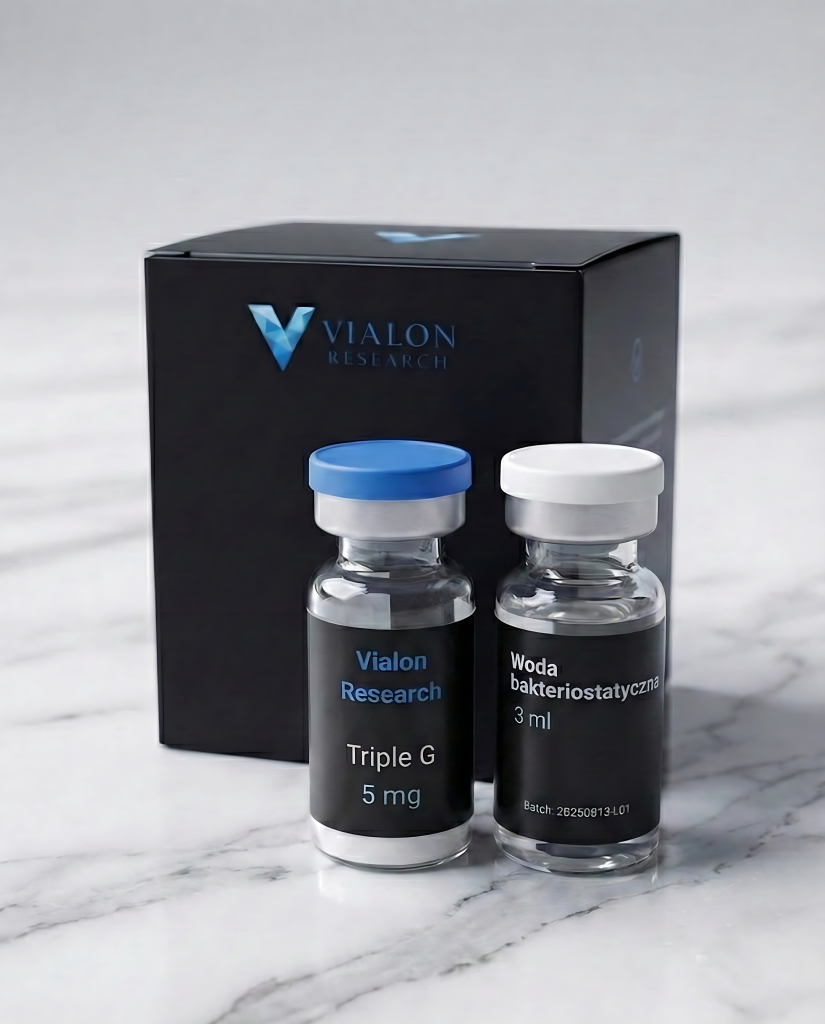
Designing a single peptide molecule capable of activating three receptors with controlled affinity is a synthetic challenge. The research triple agonist available in our catalog (39 amino acids, purity ≥98% HPLC) employs the following modifications:
- Aib at positions 2 and 20: Alpha-aminoisobutyric acid (Aib) at position 2 confers DPP-4 resistance, while at position 20 it stabilizes the alpha-helix structure, which is critical for maintaining affinity to GCGR.
- Alpha-methyl-leucine (αMeL) at position 13: A non-coded amino acid that increases conformational rigidity of the chain in the region responsible for receptor selectivity.
- C20 fatty acid acylation: A C20 acyl chain (longer than the typical C16–C18 in monoagonists) enables stronger binding to plasma albumin, extending the duration of biological activity in in vivo models.
The affinity ratios for individual receptors (GLP-1R : GIPR : GCGR) are intentionally unbalanced — typically with a dominant GLP-1R and GIPR component, with weaker but significant GCGR activity. This profile maximizes the insulinotropic effect with controlled GCGR activity (Coskun et al., 2022).
Comparison of Approaches: Mono-, Dual-, and Triple Agonism
In preclinical studies in DIO mice, a gradation of effects is observed depending on the number of receptors engaged:
- GLP-1R monoagonist: Body weight reduction ~15–20%, improved glucose tolerance, food intake inhibition. Dominant mechanism: appetite suppression + insulin modulation.
- Dual GLP-1R/GIPR agonist: Reduction ~20–25%, additional modulation of lipid metabolism, improved plasma lipid profile. Additive effect of the GIP component.
- Triple GLP-1R/GIPR/GCGR agonist: Reduction ~25–30%, additional increase in energy expenditure and thermogenesis. The GCGR component provides an effect absent in dual agonists.
It should be emphasized that the above data originate from mouse models and cannot be directly extrapolated to other species. Interspecies differences in receptor distribution, hepatic metabolism, and BAT thermogenesis represent significant translational limitations.
Frequently Asked Research Questions (FAQ)
Does the GCGR component cause hyperglycemia in animal models?
In triple agonists, GCGR activation is intentionally weaker than the GLP-1R and GIPR components. In Finan et al. (2015) studies in DIO mice, no deterioration in glucose tolerance was observed — the insulinotropic effect of both incretins compensated for the GCGR activity. In protocols using higher doses, glucose monitoring at time points is recommended.
What is the optimal animal model for triple agonist research?
The most commonly used model is C57BL/6 DIO mice (12–16 weeks of high-fat diet, 60% calories from fat). For thermogenesis studies, thermoneutral conditions (30°C) are preferred, as standard vivarium temperature (22°C) itself activates thermogenesis in mice.
How should the research triple agonist be stored?
Store lyophilisate at ≤ -20°C. After reconstitution in bacteriostatic water, stability at 2–8°C is ~21 days. Due to the C20 acyl chain, the solution has a tendency to adsorb to polypropylene tube walls — use of siliconized tubes or addition of 0.1% BSA as a carrier is recommended.
How does a triple agonist differ from administering three separate peptides?
A single triple agonist molecule ensures simultaneous activation of three receptors at the same tissue location and in fixed proportions. A cocktail of three separate peptides does not replicate this effect — differences in pharmacokinetics, distribution, and receptor proportions lead to a different activation profile. In the Finan et al. study, the triple agonist showed greater efficacy than an equimolar mixture of three monoagonists.
References
- Finan B et al. (2015). „A rationally designed monomeric peptide triagonist corrects obesity and diabetes in rodents.” Nature Medicine. 10.1038/nm.3761
- Habegger KM et al. (2013). „Fibroblast growth factor 21 mediates specific GCGR-mediated actions.” Diabetes. 10.2337/db12-1116
- Dean ED (2017). „Interrupted GCGR Signaling Reveals Hepatic α Cell Axis and Role for L-Glutamine in α Cell Proliferation.” Cell Metabolism. 10.1016/j.cmet.2017.05.011
- Coskun T et al. (2022). „LY3437943, a novel triple GIP/GLP-1/GCGR receptor agonist.” Cell Metabolism. 10.1016/j.cmet.2022.07.013
- Nauck MA, Meier JJ (2021). „The Role of Incretins on Insulin Function and Glucose Homeostasis.” Endocrinology. PMC8168943
- Day JW et al. (2009). „A new GCGR and GLP-1 co-agonist eliminates obesity in rodents.” Nature Chemical Biology. 10.1038/nchembio.209
- Willard FS et al. (2020). „Tirzepatide is an imbalanced and biased dual GIP and GLP-1 receptor agonist.” JCI Insight. JCI Insight 140532