Note: This article is purely educational and is based on peer-reviewed scientific literature. The peptides described are available exclusively as laboratory research reagents (research use only). This article does not constitute medical advice or instructions for use.
Introduction — The GH-IGF-1 Somatotropic Axis
Growth hormone (GH) secretion by somatotroph cells in the anterior pituitary is regulated by two primary signaling pathways: a stimulatory pathway (GHRH — growth hormone-releasing hormone) and a modulatory pathway (ghrelin and its GHS-R1a receptors). Under physiological conditions, both pathways operate in a pulsatile manner — GH is released in discrete pulses, predominantly nocturnal, rather than tonically. This pulsatility is critical for signaling along the GH-IGF-1 axis.
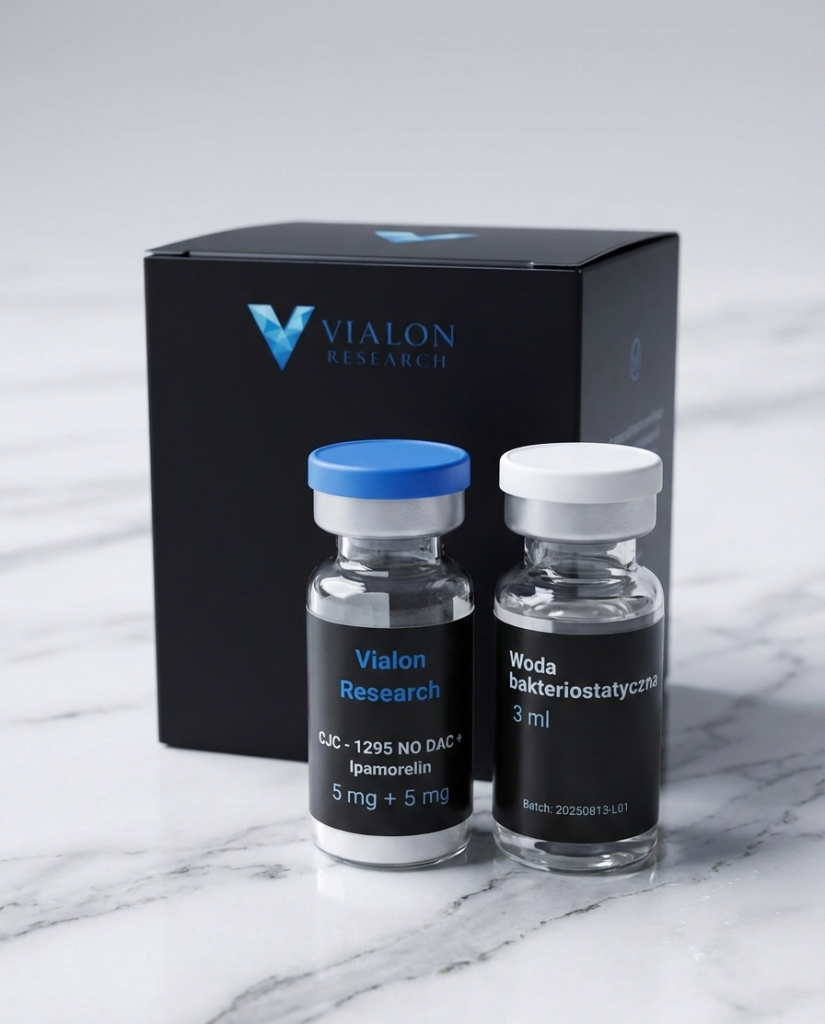
The scientific literature describes a number of synthetic analogs of both ligands that allow selective activation of each pathway. Two of them — CJC-1295 NO DAC (a modified GHRH analog) and Ipamorelin (a selective pentapeptide GH secretagogue) — are among the most thoroughly pharmacologically characterized. This article discusses their structures, molecular mechanisms, and the receptor complementarity described in the literature.
CJC-1295 NO DAC — Modified GHRH(1-29) Analog
CJC-1295 NO DAC, also known as Mod GRF 1-29 (Modified Growth Releasing Factor), is a synthetic analog of human GHRH truncated to the first 29 amino acids — the region sufficient for full activation of the GHRH-R receptor. Native GHRH(1-29) undergoes rapid enzymatic degradation in vivo (half-life <10 minutes), so the peptide incorporates four strategic amino acid substitutions:
- D-Ala² (position 2) — a D-alanine isomer conferring resistance to cleavage by dipeptidyl peptidase IV (DPP-IV), the primary enzyme degrading native GHRH peptides
- Ala⁸ (position 8) — glutamine replaced by alanine, increasing conformational stability of the α-helix
- Ala¹⁵ (position 15) — glycine replaced by alanine, rigidifying the chain in the central region
- Leu²⁷ (position 27) — leucine substituted for methionine, eliminating an oxidation-susceptible residue (see articles on peptide stability for storage considerations)
These modifications extend the peptide’s half-life while preserving full biological activity at GHRH-R. The mechanism of action involves activation of the cAMP/PKA cascade in somatotrophs, leading to transcription of the GH1 gene and exocytosis of secretory granules containing growth hormone (Teichman et al., 2006).
Ipamorelin — Selective GHS-R1a Pentapeptide
Ipamorelin (sequence: Aib-His-D-2-Nal-D-Phe-Lys-NH₂) is a synthetic pentapeptide belonging to the growth hormone secretagogue (GHS) class. It binds the ghrelin receptor GHS-R1a — a G protein-coupled receptor that activates the PLC/IP₃/Ca²⁺ pathway in somatotroph cells.
A defining feature of Ipamorelin is its high selectivity. In the landmark study by Raun et al. (European Journal of Endocrinology, 1998), which first described this peptide as „the first selective growth hormone secretagogue,” the authors demonstrated that Ipamorelin:
- Stimulates GH secretion from somatotrophs with potency comparable to GHRP-6
- Does not affect cortisol, prolactin, or aldosterone levels — unlike older secretagogues (GHRP-6, GHRP-2, Hexarelin)
- Does not stimulate ACTH secretion or adrenocortical activity
This selectivity represents an important pharmacological distinction within the GHS class. Older secretagogues such as GHRP-6, despite potent effects on the GH axis, simultaneously activate the HPA axis (hypothalamic-pituitary-adrenal), which complicates interpretation of results in experimental models.
DAC vs NO DAC — Pharmacokinetic Differences
The scientific literature describes two forms of CJC-1295 that differ in their pharmacokinetic profile:
- CJC-1295 with DAC — contains a covalently attached albumin-binding complex (Drug Affinity Complex), extending the half-life to approximately 6–8 days. This results in a tonic, continuous elevation of GH and IGF-1 levels (Teichman et al., 2006).
- CJC-1295 NO DAC (Mod GRF 1-29) — lacks the albumin modification; half-life approximately 30 minutes. Induces an acute, pulsatile GH pulse more closely resembling the physiological release pattern.
This distinction is significant from a pharmacological perspective: pulsatile GH secretion activates distinct signaling pathways in target tissues compared with continuous exposure. The pulsatile profile preferentially activates the JAK2/STAT5b pathway in the liver (responsible for IGF-1 production), whereas continuous exposure may lead to GH receptor desensitization (Veldhuis et al., 2005).
Receptor Complementarity — Two Pathways, One Axis
The rationale described in the literature for combining GHRH analogs with GHS secretagogues is grounded in receptor complementarity at the level of pituitary somatotroph cells:
- GHRH-R → cAMP/PKA — stimulates transcription of the GH1 gene and synthesis of new growth hormone
- GHS-R1a → PLC/IP₃/Ca²⁺ — amplifies exocytosis of secretory granules, releasing stored GH
The convergence of these two signaling cascades — cAMP and Ca²⁺ — at the level of the somatotroph exocytotic apparatus underlies the synergistic effect described in the literature. Bowers (2004), in a systematic review, documents that simultaneous activation of both pathways produces a response exceeding the simple sum of each pathway’s individual effects.
In the study by Anderson et al. (Clinical Endocrinology, 2001), simultaneous exposure to GHRH and GHS was shown to produce synergistic GH secretion in humans, and this effect disappeared following prior desensitization of either receptor — confirming that synergy requires concurrent activation of both receptor pathways.
Frequently Asked Questions
What is the difference between CJC-1295 NO DAC and the DAC version?
CJC-1295 with DAC (Drug Affinity Complex) carries a modification enabling binding to plasma albumin, extending its half-life to approximately 6–8 days. CJC-1295 NO DAC (Mod GRF 1-29) lacks this modification — its half-life is approximately 30 minutes, and its action profile is pulsatile, more closely resembling the physiological pattern of GH secretion.
Why is Ipamorelin described as a „selective” GH secretagogue?
Unlike older secretagogues (GHRP-6, GHRP-2, Hexarelin), Ipamorelin does not affect cortisol, prolactin, or aldosterone concentrations. It activates exclusively the GHS-R1a → GH pathway without stimulating the HPA axis. This profile has been confirmed both in vitro and in vivo (Raun et al., 1998).
What does GHRH-R and GHS-R1a receptor synergy mean?
GHRH-R and GHS-R1a activate two distinct intracellular cascades in pituitary somatotrophs: cAMP/PKA (GH synthesis) and PLC/IP₃/Ca²⁺ (GH exocytosis). Convergence of these cascades at the secretory apparatus produces a response exceeding the simple sum of effects — a phenomenon described as pharmacological synergy (Bowers, 2004; Anderson et al., 2001).
Is CJC-1295 NO DAC the same as Mod GRF 1-29?
Yes. Mod GRF 1-29 (Modified Growth Releasing Factor 1-29) and CJC-1295 NO DAC refer to the same peptide — a modified GHRH(1-29) analog with four amino acid substitutions (D-Ala², Ala⁸, Ala¹⁵, Leu²⁷). „Mod GRF 1-29” is the older convention from the scientific literature; „CJC-1295 NO DAC” distinguishes it from the DAC variant.
How should GHRH analog and GHS peptides be stored?
Lyophilized peptides should be stored at ≤ -20°C. After reconstitution in bacteriostatic water, they remain stable at 2–8°C for 14–21 days. Freeze-thaw cycles and light exposure should be avoided. Refer to articles on peptide stability for further guidance on proper handling and degradation factors.
Bibliography
- Teichman SL et al. (2006). „Prolonged stimulation of growth hormone (GH) and insulin-like growth factor I secretion by CJC-1295, a long-acting analog of GH-releasing hormone, in healthy adults.” Journal of Clinical Endocrinology & Metabolism, 91(3), 799–805. doi:10.1210/jc.2005-1536
- Raun K et al. (1998). „Ipamorelin, the first selective growth hormone secretagogue.” European Journal of Endocrinology, 139(5), 552–561. doi:10.1530/eje.0.1390552
- Bowers CY (2004). „Growth Hormone-Releasing Peptide (GHRP).” Cellular and Molecular Life Sciences, 55, 1426–1439.
- Anderson SM et al. (2001). „Synergistic effect of growth hormone-releasing hormone and growth hormone-releasing peptide on GH secretion.” Clinical Endocrinology, 55(4), 533–539.
- Veldhuis JD et al. (2005). „Pulsatile vs continuous GH signaling: Differential effects on target tissue responsiveness.” Proceedings of the National Academy of Sciences.
- Hansen BS et al. (1999). „Ipamorelin: pharmacological characterization in vitro and in vivo.” Journal of Endocrinology, 161(1), 1–6.