Notice: The following article is for educational and informational purposes only. The substances described are intended for research and laboratory use only. This does not constitute medical advice or encouragement to use these substances in humans or animals.
Introduction
CJC-1295 is a synthetic analog of Growth Hormone Releasing Hormone (GHRH). It exists in two research variants that — despite sharing the same peptide core — differ fundamentally in pharmacokinetics, half-life, and the nature of somatotropic axis stimulation. Understanding these differences is essential when designing research protocols.
Both variants derive from modifications of native GHRH(1-29) — the first 29 amino acids of human growth hormone releasing hormone. Native GHRH(1-29) — also known as sermorelin — has a very short half-life (a few minutes in vivo), which limits its research utility. CJC-1295 addresses this through four amino acid substitutions that increase resistance to enzymatic degradation.
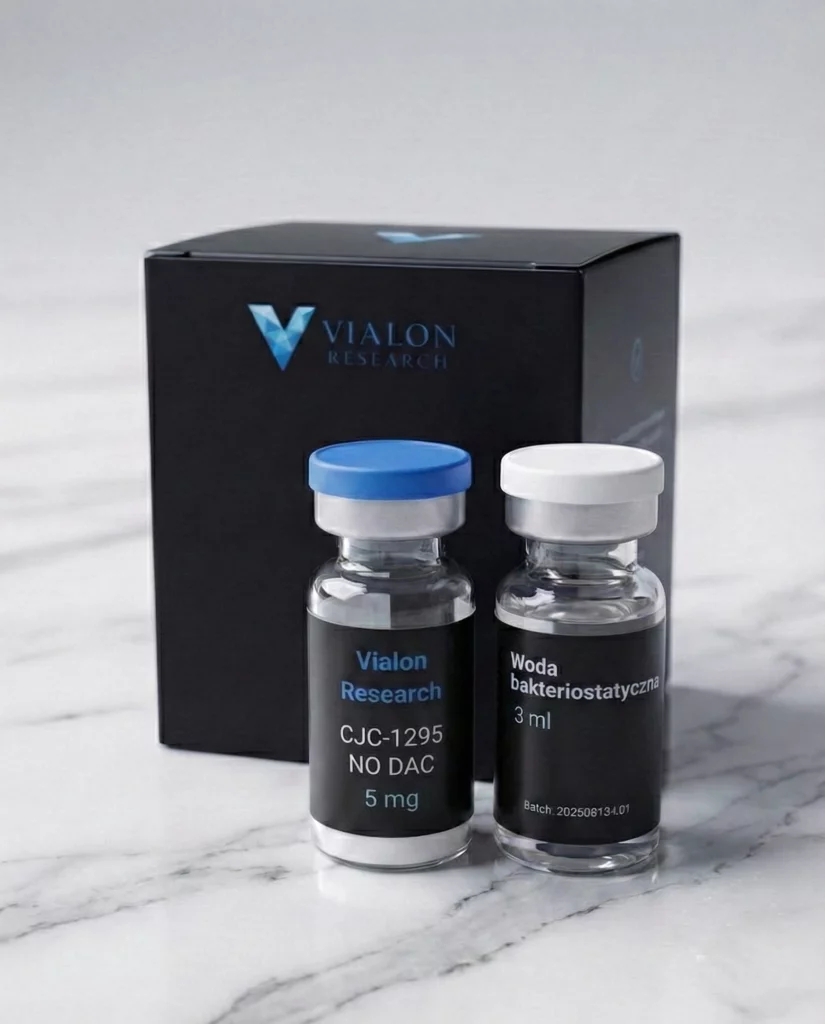
Our catalog includes CJC-1295 NO DAC (Mod GRF 1-29) with ≥98% HPLC purity, as well as a ready-to-use CJC-1295 NO DAC + Ipamorelin blend combining two complementary growth hormone secretion pathways.
What is CJC-1295?
CJC-1295 is a modified GHRH(1-29) analog with 29 amino acids, developed to extend the half-life of the native hormone. Four key amino acid substitutions distinguish it from natural GHRH:
- Position 2: Ala → D-Ala — replacing L-alanine with D-alanine protects the N-terminus of the peptide from degradation by dipeptidyl peptidase IV (DPP-IV), the enzyme responsible for rapid inactivation of native GHRH
- Position 8: Asn → Asp — eliminates the deamidation-susceptible asparagine residue
- Position 15: Gly → Ala — increases α-helix stability in the middle portion of the peptide
- Position 27: Met → Leu — removes the oxidation-prone methionine residue, the primary cause of biological activity loss under storage conditions
These modifications extend the half-life from a few minutes (native GHRH) to approximately 30 minutes (CJC-1295 NO DAC). CAS number: 863288-34-0, molecular weight ~3367.9 Da.
CJC-1295 DAC vs NO DAC — key differences
This is the most important section of this article. The DAC and NO DAC variants differ by a single modification that fundamentally changes the pharmacological profile of the peptide.
CJC-1295 NO DAC (Mod GRF 1-29)
The NO DAC variant is the „pure” modified GHRH(1-29) analog — 29 amino acids with the four substitutions described above, without any additional chemical modifications. It is commonly referred to as Mod GRF 1-29 (Modified Growth Releasing Factor, amino acids 1-29).
Key characteristics:
- Half-life: ~30 minutes in vivo
- Stimulation pattern: pulsatile — mimics the physiological GHRH secretion pattern from the hypothalamus
- Molecular weight: ~3367.9 Da
- Albumin binding: no
The pulsatile stimulation pattern is a key advantage of the NO DAC variant in research. Physiologically, GHRH is released from the hypothalamus in pulses every 60–120 minutes, and the somatotrophs of the anterior pituitary respond most strongly to pulsatile rather than continuous stimulation. The NO DAC variant mimics this pattern.
CJC-1295 DAC (Drug Affinity Complex)
The DAC variant shares the same 29-amino-acid core but carries an additional chemical modification — a covalently attached MPA (maleimidopropionic acid) linker. The MPA linker forms a covalent bond with plasma albumin after administration, creating a peptide-albumin complex with a significantly increased effective mass (~70 kDa with albumin).
Key characteristics:
- Half-life: ~6–8 days in vivo
- Stimulation pattern: continuous (tonic) — maintains elevated GHRH-R receptor stimulation for several days
- Molecular weight: ~3647.3 Da (peptide alone, without albumin)
- Albumin binding: yes, covalent (MPA linker)
The dramatically extended half-life (from 30 minutes to 6–8 days) shifts the stimulation pattern from pulsatile to continuous. This is a fundamental difference — continuous GHRH-R receptor stimulation produces a different growth hormone secretion profile compared to pulsatile stimulation, and may lead to receptor desensitization with prolonged administration.
Comparison table
Summary of key differences between CJC-1295 variants:
| Parameter | CJC-1295 NO DAC | CJC-1295 DAC |
|---|---|---|
| Other name | Mod GRF 1-29 | CJC-1295 with DAC |
| Half-life | ~30 minutes | ~6–8 days |
| Stimulation pattern | Pulsatile | Continuous (tonic) |
| Albumin binding | No | Yes (MPA linker) |
| Molecular weight | ~3368 Da | ~3647 Da |
| Physiological relevance | Mimics GHRH pulsatility | Deviates from physiology |
| Desensitization risk | Low | Elevated |
Mechanism of action — the GHRH-R receptor
Both CJC-1295 variants act as agonists of the GHRH-R receptor (Growth Hormone Releasing Hormone Receptor) — a Gs protein-coupled membrane receptor located on somatotrophs of the anterior pituitary gland.
Signaling cascade following GHRH-R activation:
- Ligand binding — CJC-1295 binds to the N-terminal extracellular domain of the GHRH-R receptor
- Gs protein activation — conformational change in the receptor activates the α subunit of the Gs protein
- cAMP elevation — activation of adenylyl cyclase (AC) increases intracellular cyclic AMP concentration
- PKA activation — cAMP activates protein kinase A (PKA)
- GH1 transcription — PKA phosphorylates the transcription factor CREB, which activates the GH1 gene promoter
- GH secretion — synthesis and release of growth hormone from somatotroph secretory granules
Importantly, GHRH-R is not the only regulator of GH secretion. A second pathway — the growth hormone secretagogue receptor GHS-R1a (ghrelin receptor) — operates independently of GHRH-R. Simultaneous stimulation of both receptors produces a synergistic effect, which is the scientific basis for combining CJC-1295 NO DAC with Ipamorelin (a selective GHS-R1a agonist). More on this synergy in the article: CJC-1295 NO DAC and Ipamorelin — synergy of two GH secretion pathways.
CJC-1295 NO DAC + Ipamorelin — pathway synergy
One of the most common research protocols combines CJC-1295 NO DAC with Ipamorelin. The scientific rationale is straightforward: both peptides stimulate growth hormone secretion but through two entirely independent signaling pathways.
- CJC-1295 NO DAC → GHRH-R receptor → cAMP/PKA cascade → GH transcription and release
- Ipamorelin → GHS-R1a receptor → IP3/DAG/PKC cascade → Ca²⁺ mobilization → GH release
Ipamorelin is the preferred GHS-R1a agonist in research due to its high selectivity — unlike GHRP-2 or GHRP-6, it shows no significant effect on the corticotropic axis (ACTH/cortisol) or prolactin. This selectivity simplifies the interpretation of research results.
Our catalog includes a ready-to-use CJC-1295 NO DAC + Ipamorelin blend, combining both peptides in a single vial at a 1:1 ratio (5 mg of each in the 10 mg variant).
Storage and stability
CJC-1295 NO DAC is supplied as a white lyophilized powder. Proper storage is essential to preserve biological activity:
- Lyophilized powder: store at ≤ -20°C, protected from moisture and light. Stability exceeds 24 months.
- After reconstitution: solution in bacteriostatic water should be stored at 2–8°C and used within 14 days.
- Note: the Met²⁷→Leu substitution in the CJC-1295 sequence eliminates the primary source of oxidative degradation, significantly improving stability compared to native GHRH(1-29).
Peptide degradation mechanisms and the importance of the Met²⁷→Leu substitution for long-term stability are fundamental considerations when planning research storage protocols. Proper lyophilized peptide storage at ≤ -20°C combined with bacteriostatic water reconstitution at 2–8°C ensures preserved biological activity throughout the research period.
Frequently asked questions
What is CJC-1295?
CJC-1295 is a synthetic GHRH(1-29) analog with 29 amino acids and four substitutions that increase resistance to proteolysis (D-Ala², Asp⁸, Ala¹⁵, Leu²⁷). It acts as an agonist of the GHRH-R receptor on pituitary somatotrophs. CAS number: 863288-34-0.
What is the difference between CJC-1295 DAC and NO DAC?
The DAC variant has a covalently attached MPA linker (Drug Affinity Complex) that binds to plasma albumin. This extends the half-life from ~30 minutes (NO DAC) to ~6–8 days (DAC) and changes the stimulation pattern from pulsatile to continuous. The NO DAC variant more closely mimics the physiological GHRH secretion pattern.
What is Mod GRF 1-29?
Mod GRF 1-29 (Modified Growth Releasing Factor 1-29) is an alternative name for CJC-1295 NO DAC. It refers to the modified GHRH fragment spanning amino acids 1-29 with four substitutions that increase metabolic stability.
Why is CJC-1295 NO DAC combined with Ipamorelin?
CJC-1295 NO DAC (GHRH-R agonist) and Ipamorelin (GHS-R1a agonist) act through two independent growth hormone secretion pathways. Simultaneous stimulation of both receptors produces a synergistic effect. Ipamorelin is preferred for its selectivity — it does not affect ACTH, cortisol, or prolactin. A ready-to-use blend is available in our store.
What is the half-life of CJC-1295 NO DAC?
The half-life of CJC-1295 NO DAC is approximately 30 minutes in vivo — significantly longer than native GHRH(1-29), which is inactivated by DPP-IV within minutes. The D-Ala substitution at position 2 is the primary modification responsible for protection against enzymatic degradation.
Bibliography
- Teichman SL et al. (2006). „Prolonged stimulation of growth hormone (GH) and insulin-like growth factor I secretion by CJC-1295, a long-acting analog of GH-releasing hormone, in healthy adults.” J Clin Endocrinol Metab, 91(3):799–805. doi:10.1210/jc.2005-1536
- Ionescu M, Bhm LL (2004). „Growth hormone-releasing hormone receptor splice variant causes loss of GH secretagogue receptor binding in the pituitary.” J Biol Chem, 279(36):37105–37114.
- Raun K et al. (1998). „Ipamorelin, the first selective growth hormone secretagogue.” Eur J Endocrinol, 139(5):552–561. doi:10.1530/eje.0.1390552
- Alba M et al. (2006). „Once-daily administration of CJC-1295, a long-acting growth hormone-releasing hormone (GHRH) analog, normalizes growth in the GHRH knockout (GHRHKO) mouse.” Am J Physiol Endocrinol Metab, 291(6):E1290-E1294. doi:10.1152/ajpendo.00172.2006
- Veldhuis JD et al. (2008). „Somatotropic axis in aging: physiology of GH pulsatility.” Growth Horm IGF Res, 18(5):431–442. doi:10.1016/j.ghir.2008.03.002
- Nass R et al. (2008). „Effects of an oral ghrelin mimetic on body composition and clinical outcomes in healthy older adults.” Ann Intern Med, 149(9):601–611.