Variability of HPLC and MS Laboratory Analysis Results
TL;DR: Laboratory analysis results can differ even for the same test material, because methods such…

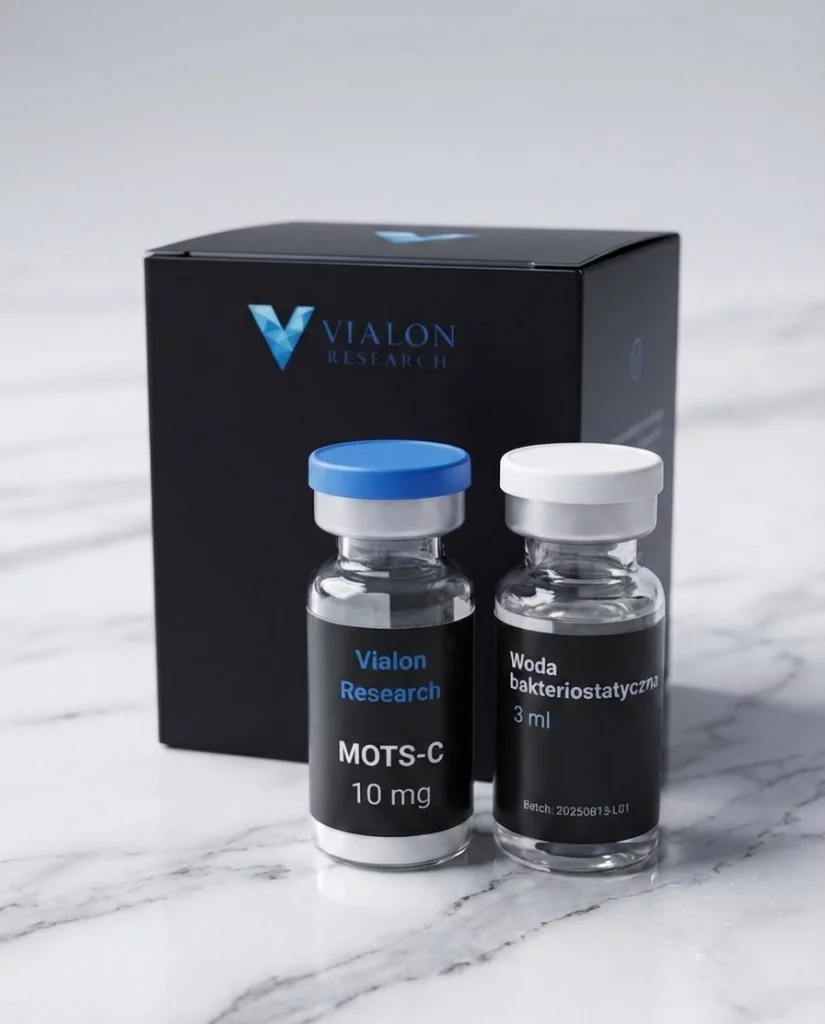
Mitochondrial-derived peptide · 16 amino acids · CAS 1627580-64-6
| Parameter | Value |
|---|---|
| Molecular formula | C₁₀₁H₁₅₂N₂₈O₂₂S₂ |
| Molecular weight | ~2174.6 Da |
| Amino acid count | 16 |
| Sequence | MRWQEMGYIFYPRKLR |
| CAS number | 1627580-64-6 |
| PubChem CID | 146675088 |
| Physical form | White lyophilized powder |
| Purity | ≥98% (RP-HPLC) |
| Classification | Chemical reagent / research material |
| Intended use | For in vitro research use only, not for use in humans or animals |
Not classified as a hazardous substance under CLP regulation. Offered as a chemical reagent for in vitro laboratory use, within the framework of applicable European Union chemical substances regulations (REACH, CLP).
Reconstitution and storage conditions:
Typical analytical equipment:
All working parameters should be selected according to the research laboratory’s internal protocol. Product intended exclusively for in vitro and analytical use; not for human or animal use.
MOTS-C (Mitochondrial Open Reading Frame of the 12S rRNA Type-C) is a 16-amino acid mitochondrial-derived peptide (MDP). Unlike most biologically active peptides, MOTS-C is not encoded by nuclear DNA but by the MT-RNR1 gene (12S rRNA) located in the mitochondrial genome. The peptide was first identified and described in 2015 by Changhan David Lee's research group at the University of Southern California.
The sequence MRWQEMGYIFYPRKLR with a mass of ~2174.6 Da contains two methionine residues (positions 1 and 6), making the molecule susceptible to oxidation. MOTS-C belongs to a new class of signaling molecules — mitochondrial-derived peptides (MDPs), alongside humanin and the SHLP1-6 family. The discovery that the mitochondrial genome encodes short peptides with regulatory functions opened a new research direction into retrograde communication between mitochondria and the cell nucleus.
The central element of the molecular mechanism of MOTS-C, described in cellular and mouse models, is activation of AMPK (AMP-activated protein kinase), a key cellular energy sensor. MOTS-C does not activate AMPK directly but acts on a metabolic pathway upstream in the cascade, targeting the AICAR transformylase enzyme (ATIC) in the folate-methionine cycle.
Inhibition of ATIC by MOTS-C leads to accumulation of endogenous AICAR (5-aminoimidazole-4-carboxamide ribonucleotide), an intermediate metabolite in de novo purine synthesis. AICAR is a well-known AMPK activator, which explains the indirect mechanism of kinase activation by the peptide. Consequently, MOTS-C inhibits de novo purine biosynthesis, affecting cellular metabolism and energy homeostasis in the studied mouse models.
In 2018, Lee's group demonstrated in cell cultures that under metabolic stress conditions, MOTS-C translocates to the cell nucleus, where it regulates expression of nuclear genes related to stress response. This observation suggests that a mitochondrial-derived peptide can serve as a signaling molecule in retrograde mitochondria-to-nucleus communication.
MOTS-C was described by Lee C, Zeng J, Drew BG, et al. in a landmark 2015 publication in Cell Metabolism (21(3):443-454). The authors identified the peptide as a product of an open reading frame in the 12S rRNA gene of mitochondrial DNA and demonstrated its ability to regulate metabolic homeostasis in cellular models [1].
In the same publication, Lee et al. described the molecular mechanism: MOTS-C targets the ATIC enzyme in the folate-methionine cycle, leading to AICAR accumulation and AMPK activation. Kim SJ, Xiao J, Wan J, Cohen P, and Yen K in a Journal of Physiology review (2017, 595(21):6613-6621) discussed the role of MOTS-C and other MDPs as a new class of signaling molecules [1,2].
Kim KH, Son JM, Benayoun BA, and Lee C (2018) demonstrated in Cell Metabolism (28(3):516-524) that under metabolic stress, MOTS-C translocates to the cell nucleus, where it regulates expression of genes related to antioxidant response. This was the first report of a mitochondrial-derived peptide serving a direct regulatory function in the nucleus [3].
In the original work by Lee et al. (2015), studies on C57BL/6J mice demonstrated significant changes in metabolic parameters, including improved insulin sensitivity measured by glucose tolerance test and changes in folate cycle metabolite profiles. Increased oxygen consumption and metabolic activity in muscle tissue were shown, correlating with enhanced AMPK phosphorylation [1].
MOTS-C is a 16-amino acid peptide with a mass of ~2175 Da, characterized by:
Selected publications on the mitochondrial-derived peptide MOTS-C.
"The mitochondrial-derived peptide MOTS-c promotes metabolic homeostasis and reduces obesity and insulin resistance"
Cell Metabolism, 21(3):443-454
"Mitochondrial-derived peptides as novel regulators of metabolism"
Journal of Physiology, 596(24):6023-6036
Produkt jest surowcem chemicznym przeznaczonym wyłącznie do zastosowań badawczych, naukowych i analitycznych in vitro. Nie jest przeznaczony do użytku ludzkiego ani weterynaryjnego, w tym w celach diagnostycznych, terapeutycznych, profilaktycznych lub żywieniowych.
Produkt nie jest sklasyfikowany jako substancja niebezpieczna zgodnie z rozporządzeniem CLP (WE) nr 1272/2008. Oferowany jest jako odczynnik chemiczny w ramach obowiązujących w Unii Europejskiej przepisów dotyczących substancji chemicznych (REACH, CLP). Nie stanowi produktu leczniczego, suplementu diety, wyrobu medycznego ani kosmetyku w rozumieniu obowiązujących przepisów prawa.
Substancję niewykorzystaną należy utylizować zgodnie z lokalnymi przepisami dotyczącymi odpadów chemicznych. W warunkach laboratoryjnych: neutralizować i utylizować wraz z odpadami laboratoryjnymi. Nie wylewać do kanalizacji.
Produkt oferowany jest zgodnie z obowiązującymi przepisami Unii Europejskiej dotyczącymi substancji chemicznych (REACH, CLP) oraz prawem polskim w zakresie obrotu odczynnikami chemicznymi i materiałami badawczymi. Pełne warunki sprzedaży oraz klasyfikacja produktu zawarte są w Regulaminie Sklepu.
Dokonując zakupu, Klient potwierdza zapoznanie się z powyższymi informacjami oraz akceptuje postanowienia Regulaminu.
W przypadku pytań dotyczących obchodzenia się z produktem lub informacji regulacyjnych: kontakt@peptydy-sklep.com.
Ověřená hodnocení zákazníků tohoto produktu
Działa



TL;DR: Laboratory analysis results can differ even for the same test material, because methods such…
TL;DRThis article explains how HPLC/MS is widely used as a set of laboratory analytical methods…
Reading a COA requires verifying the batch, analytical methods, acceptance criteria, and test results.
MOTS-C (Mitochondrial Open Reading Frame of the 12S rRNA Type-C) is a 16-amino acid peptide encoded by the mitochondrial genome. It was discovered in 2015 by the Lee laboratory at USC. CAS: 1627580-64-6.
MOTS-C is one of the few known peptides encoded by mitochondrial DNA rather than nuclear DNA. It is classified as a mitochondrial-derived peptide (MDP) and has been shown to activate the AMPK signaling pathway in cell culture studies.
Store lyophilized MOTS-C at -20°C to -80°C. After reconstitution, store at 2-8°C and use within 30 days. Avoid repeated freeze-thaw cycles.
MOTS-C is available as a 10 mg lyophilized vial.
MOTS-C research spans metabolic signaling (AMPK pathway), mitochondrial biology, and the emerging field of mitochondrial-derived peptides. It represents a novel class of signaling molecules originating from the mitochondrial genome.