Proper peptide storage is the foundation of every reproducible experiment. Even the purest peptide (≥98% HPLC) loses activity if stored incorrectly — and degradation is often invisible to the naked eye. This guide covers specific storage conditions for lyophilized powders and reconstituted solutions, the most common mistakes, and practical reference tables you can print and hang by your freezer.
If you want to first understand why peptides degrade — read our article on peptide stability and degradation. Here we focus on how to prevent it in practical laboratory settings.
Lyophilized Peptides — How to Store Dry Powders
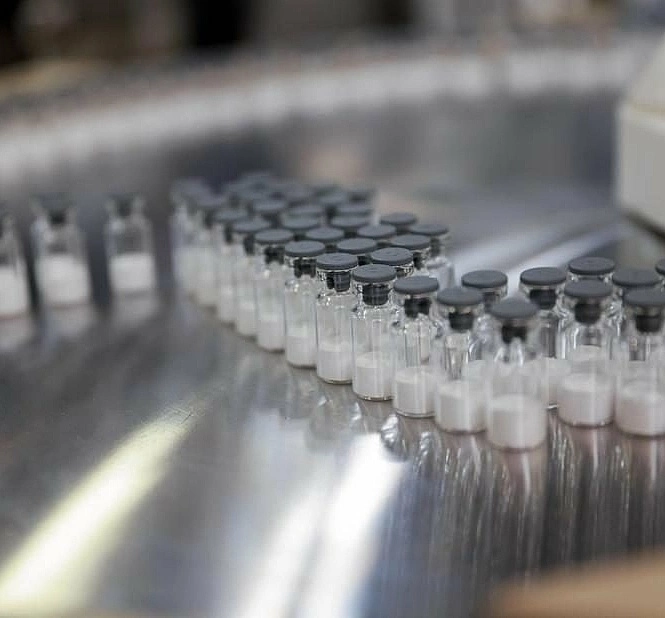
Lyophilization (freeze-drying) is the most effective method for stabilizing peptides. In dry powder form, a peptide is resistant to hydrolysis — the absence of water eliminates the primary catalyst for degradation. This is why lyophilizates maintain stability many times longer than solutions.
Key guidelines for lyophilized peptides:
- Temperature -20°C — the standard for most peptides. At this temperature, lyophilizates maintain stability for 2–5 years, depending on the sequence.
- Temperature -80°C — optimal for sensitive peptides (containing Met, Cys, Trp) and very long-term storage (>5 years). Practically eliminates all chemical reactions.
- Temperature 2–8°C (refrigerator) — acceptable for short-term storage (weeks). Convenient when the peptide is in frequent use.
- Room temperature (20–25°C) — safe for a few days. During shipping, a lyophilizate survives transport without dry ice, but should be refrigerated promptly upon receipt.
Additional precautions:
- Use desiccant (silica gel) in the container with vials — even minimal moisture penetrates through the septum.
- Store vials in a dark place or wrap in aluminium foil — UV radiation accelerates photodegradation, especially for peptides containing Trp and Tyr.
- Avoid repeatedly opening the freezer — temperature fluctuations cause condensation on the vial walls, leading to hydrolysis.
- Before opening a vial from the freezer, allow it to reach room temperature (15–30 minutes) — this prevents moisture condensation on the powder.
Solutions — Storage After Reconstitution
Once a peptide is dissolved, the clock starts ticking. Water enables hydrolysis, oxidation, and aggregation — the three main degradation pathways for peptides in solution. A proper reconstitution and storage protocol minimises these processes.
Step by Step: Reconstitution and Storage
- Choose your solvent — most commonly bacteriostatic water (0.9% benzyl alcohol) ensures sterility and inhibits microbial growth. Alternatives include sterile water for injection or saline — the choice depends on the research protocol.
- Dissolve slowly — add solvent along the vial wall, not directly onto the powder. Gently rotate the vial (do not shake!), until the peptide is completely dissolved.
- Aliquot immediately — divide the solution into single-use portions in sterile Eppendorf tubes. Label with date, concentration, and lot number.
- Freeze the aliquots — anything you do not plan to use within 2–4 weeks should be frozen at -20°C. Aliquots for long-term storage should be placed at -80°C.
- Thaw only once — every freeze-thaw cycle damages the peptide structure. Thaw in the refrigerator (2–8°C), never at room temperature.
Solution Stability — Solvent Comparison
| Solvent | Temperature | Approximate stability | Notes |
|---|---|---|---|
| Bacteriostatic water | 2–8°C | up to 4 weeks | Most common choice; benzyl alcohol inhibits bacterial growth |
| Sterile water (WFI) | 2–8°C | up to 2 weeks | No preservative — higher contamination risk |
| Saline (0.9% NaCl) | 2–8°C | up to 3 weeks | Physiological pH; suitable for peptides sensitive to osmolarity |
| Any solvent | -20°C | 3–6 months | Frozen aliquots; avoid repeated thawing |
| Any solvent | -80°C | 6–12+ months | Longest stability for solutions; ultra-low freezer required |
Key factors affecting solution stability:
- pH — optimal pH 5–6 for most peptides. Extreme values (below 3 or above 9) accelerate hydrolysis of peptide bonds.
- Sensitive amino acids — methionine (Met), cysteine (Cys), and tryptophan (Trp) are particularly prone to oxidation. Peptides containing these residues require protection from oxygen (argon/nitrogen atmosphere) and light.
- Concentration — higher peptide concentrations promote aggregation. Prepare working solutions at the concentration specified by the research protocol.
Most Common Peptide Storage Mistakes
Based on scientific literature and laboratory experience — here are the mistakes that most frequently lead to loss of peptide activity:
- Repeated freeze-thaw cycles — each cycle causes micro-fractures in structure and aggregation. Solution: aliquot the solution into single-use portions immediately after reconstitution.
- No desiccant — moisture in the air penetrates through the vial septum and initiates hydrolysis even in lyophilized powder. Solution: store vials in a sealed container with silica gel.
- Opening a frozen vial immediately — a cold vial condenses moisture from the air onto its walls and directly onto the powder. Solution: allow the vial to reach room temperature before opening (15–30 minutes).
- Exposure to light — UV radiation and daylight degrade aromatic amino acids (Trp, Tyr, Phe). Solution: store in darkness or wrap vials in aluminium foil.
- No labelling — without an opening date, lot number, and concentration, there is no way to assess whether the peptide is still active. Solution: label every vial and aliquot — record date, concentration, and LOT number.
- Storing solutions at room temperature — at 20–25°C, degradation in solution proceeds many times faster than at 2–8°C. Solution: after withdrawing the required volume, return the vial to the refrigerator immediately.
Quick Reference Table — Temperature and Storage Duration
The table below summarises indicative storage periods for lyophilizates and solutions at various temperatures. Values apply to typical synthetic peptides of ≥98% purity — peptides with particularly sensitive residues (Met, Cys, Trp) fall at the lower end of the ranges.
| Form | -80°C | -20°C | 2–8°C (refrigerator) | 20–25°C (RT) |
|---|---|---|---|---|
| Lyophilizate (dry powder) | 5–10+ years | 2–5 years | weeks–months | days (max. 1 week) |
| Solution (after reconstitution) | 6–12+ months | 3–6 months | 2–4 weeks | hours (up to 24h) |
How to read this table: values are indicative ranges under correct storage conditions (sealed containers, darkness, desiccant for lyophilizates). Actual stability depends on the peptide sequence, purity, and storage conditions.
How to Tell if a Peptide Has Degraded
Peptide degradation is not always visible, but there are both simple and advanced verification methods:
- Visual inspection of lyophilizate — a properly stored lyophilizate is a white or cream-coloured, fluffy powder. Yellowing, clumping, altered texture, or stickiness may indicate degradation or moisture absorption.
- Visual inspection of solution — a fresh peptide solution is clear and colourless. Turbidity, precipitate, or colour change suggest aggregation or contamination.
- HPLC analysis — liquid chromatography is the gold standard. Comparing a chromatogram against earlier results shows how much peptide has degraded. A purity drop of >5% indicates significant degradation.
- Mass spectrometry (MS) — enables identification of specific degradation products (deamidation, oxidation, fragmentation). HPLC and MS are the standard analytical methods for peptide purity confirmation.
Frequently Asked Questions (FAQ)
How long can peptides be stored in the refrigerator?
Lyophilizates (dry powders) in the refrigerator (2–8°C) remain stable for several weeks to several months. Reconstituted solutions — up to 2–4 weeks at 2–8°C, depending on the solvent and peptide sequence. For long-term storage, always use a freezer (-20°C or -80°C).
Can peptides be left at room temperature?
Lyophilizates tolerate room temperature for a few days (e.g. during shipping) without significant degradation. Solutions should not be kept at room temperature for more than a few hours — after withdrawing the required volume, return the vial to the refrigerator immediately.
How should peptides be aliquoted correctly?
Immediately after reconstitution, divide the solution into single-use portions in sterile tubes (e.g. 0.5 ml Eppendorf). Label each tube with date, concentration, and LOT number. Freeze aliquots at -20°C (or -80°C for sensitive sequences). When using, thaw only one portion — never refreeze a thawed aliquot.
Is bacteriostatic water better than sterile water?
Yes, for most applications. Bacteriostatic water contains 0.9% benzyl alcohol, which inhibits microbial growth — the solution remains sterile for longer. Sterile water (WFI) contains no preservative, so once a vial is opened, contamination occurs more quickly. The choice depends on the research protocol.
Is desiccant necessary when storing lyophilized peptides?
Absolutely. Even a capped vial with a septum is not completely airtight — air moisture permeates through the rubber closure. Silica gel desiccant in the container with the vials absorbs moisture and significantly extends lyophilizate stability. It is a simple and inexpensive protective measure.
How can you identify a degraded peptide without a laboratory?
Lyophilizate: check the colour (should be white or cream) and consistency (fluffy powder). Yellowing, clumping, or stickiness suggests degradation. Solution: should be clear and colourless — turbidity, precipitate, or colour change are warning signs. Keep in mind, however, that many forms of degradation are invisible macroscopically — a reliable assessment requires HPLC analysis.
Sources
- Manning M.C. et al. (2010) — „Stability of protein pharmaceuticals: an update.” Pharmaceutical Research, 27(4), 544-575. DOI: 10.1007/s11095-009-0045-6
- Hossler P. et al. (2015) — „Stability of peptide 1 in human plasma.” PMC. PMC4317691
- ChemPep Inc. — „Peptide Storage & Handling Guidelines.” chempep.com
- SB-Peptide — „Peptide Handling & Storage.” sb-peptide.com
- Verified Peptides (2025) — „Lyophilized Peptide Storage: Temperature, Humidity & Light.” verifiedpeptides.com
- Wang W. (2015) — „Instability, stabilization, and formulation of liquid protein pharmaceuticals.” International Journal of Pharmaceutics, 185(2), 129-188. DOI: 10.1016/S0378-5173(99)00152-0